Gordina Journal
The Poppy
After the Flower
The Poppy begins with the seed pod that remains after the petals have fallen. Gordina reduces two pods and their stems to a continuous embroidered line on linen.
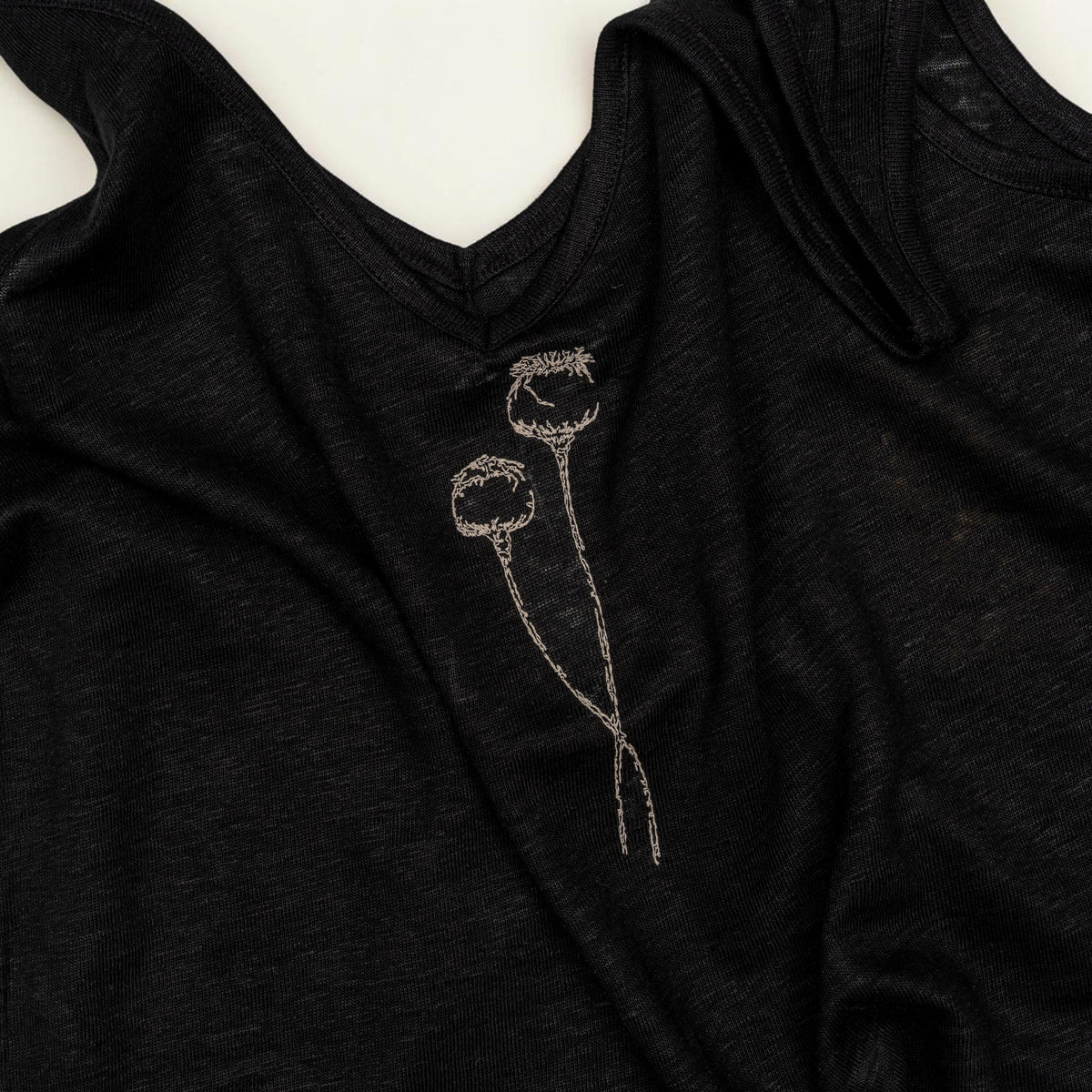
The Poppy begins after the flower. Its starting point is the seed pod: the compact rounded form that remains on the stem when the petals have fallen.
Rather than illustrating the whole plant, Gordina isolates two poppy pods and draws them as a continuous line. The result is light and spare — a botanical observation reduced to contour, spacing and movement.
After the flower
The poppy is often recognised first by its petals, but the plant has another distinctive silhouette after flowering. The seed capsule rises above the stem with a rounded body and a flattened crown, giving the plant a very different visual character.
That later stage is what interests The Poppy. The motif does not try to preserve the drama of the bloom. It looks instead at what remains: two slender stems, two seed heads and the open space between them.

A botanical form reduced to line
The embroidery is built from contour rather than fill. A single continuous line traces the two pods and their stems, allowing the linen beneath to remain visible inside and around the drawing.
This reduction is intentional. The seed pod is recognisable without being fully described. Small differences in the curve of the stems and the shape of the heads keep the two forms from becoming perfectly symmetrical.
The surrounding cloth is not empty background. It is part of the composition.

Why the seed pod?
The seed pod marks a transition. The flower has passed, but the plant has not disappeared. Its shape becomes quieter, more structural and more architectural.
That change is what gives the motif its character. The design is not about a flower at its most decorative moment. It is about the form that follows.
Historical artists and designers have also been drawn to this silhouette. The Metropolitan Museum of Art preserves works in which the poppy seed pod remains identifiable even when translated into very different media, from botanical drawing to decorative arts. The shape endures because its outline is so distinct.
From drawing to thread
Embroidery gives the line physical weight. From a distance, the motif reads almost like a pen drawing at the neckline. Up close, the thread reveals texture, direction and small variations in the stitched contour.
On Black and Olive Green linen, cream thread creates enough contrast for the drawing to remain clear without overwhelming the garment.

Placement changes the gesture
The Poppy can be embroidered at the front or back neckline. The drawing itself remains unchanged, but placement alters how it is encountered.
At the front, the motif sits close to the face and collarbone, reading as a small botanical mark. At the back, it becomes something discovered as the wearer turns away.
This choice is part of the piece rather than an afterthought: the same motif can feel intimate or unexpected depending on where it sits.

A form carried forward
The Poppy does not reproduce a historical botanical plate or museum object. Its design begins with direct observation of a familiar plant form: the seed pod after flowering.
Museum references help place that form within a longer visual history, but the embroidery itself is Gordina’s contemporary botanical interpretation — reduced to two stems, two pods and a line of thread.