

 The Ward — Faded Black€89,00 EUR
Chapter 01 — Signs of Civilization
Embroidered stories, made to wear.
An independent Dutch brand creating embroidered cotton T-shirts. Motifs informed by textile history and storytelling, embroidered in our Nuenen studio.


The Patterns
A symbol. A gesture. A trace. Follow the stories we carry into thread.


N°01Ancient Egypt · Renewal
The Scarab
A small symbol of beginning again.
The scarab begins with an ancient Egyptian observation: a beetle moving across the earth, the sun returning to the sky. Associated with renewal and transformation, its form becomes burgundy embroidery on faded grey cotton. A familiar daily garment carries the thought of another beginning.
Embroidered in the Gordina studio, the Netherlands.


From the source
A dancer, among roses.
The reference is a painted chest design recorded on paper in a 1938 portfolio of Spanish Colonial design in New Mexico. That date belongs to the portfolio, rather than the original furniture. The skirt, the gesture and the flowers give the small figure her character; embroidery brings those details onto cloth.
N°02New Mexico · A 1938 portfolio
La Bailarina
A dance carried off the page.
A woman in a fringed skirt, roses in bloom. La Bailarina began with a painted chest design recorded in a 1938 portfolio of Spanish Colonial folk art from New Mexico. We carried the dancer’s gesture into thread. The figure now moves with the person wearing her.
Embroidered in the Gordina studio, the Netherlands.


From the source
One shape. Then another.
Our reference preserves a repeating cross motif, but does not record the carpet’s maker or origin. Unsigned keeps that uncertainty in its name. The translation into embroidery follows the geometry and intervals of the repeat, giving the plain cloth around each shape a role in the composition.
N°03An anonymous carpet · A repeating cross
Unsigned
The maker is unknown. The rhythm remains.
One cross, a pause, then another. Unsigned begins with a carpet motif whose maker and origin are unrecorded in our reference. Repeated vertically down the back, the small forms find a new rhythm on cotton. The name holds a place for the attribution that is missing.
Embroidered in the Gordina studio, the Netherlands.


From the source
The shape of a fragment.
The starting point is the appearance of a worn Egyptian papyrus fragment. Its exact origin remains untraced. Gordina’s embroidery interprets the arrangement of marks and gaps as a visual composition; we do not assign a translation to the signs. Their spacing gives the eye a path across the fabric.
N°04Egyptian papyrus · An untraced fragment
The Papyrus
Something continues beyond the edge.
A torn edge. A line of marks. The Papyrus takes its cue from an Egyptian papyrus fragment whose exact origin remains untraced. We follow its shapes and intervals in thread, leaving cotton visible between them. The piece carries the visual memory of writing, with room for what is missing.
Embroidered in the Gordina studio, the Netherlands.


From the source
What remains after flowering.
Two poppy seed pods provide the motif’s shape: rounded heads balanced on fine stems. The drawing follows their contours without filling them in. Seen at a distance, the embroidery reads as a line; closer up, its stitches give the botanical detail a physical presence.
N°05A botanical observation · Two seed pods
The Poppy
After the flower, another kind of beauty.
The petals have gone; two seed pods remain on their stems. The Poppy follows their rounded heads and slender stalks in a continuous line at the neckline. Open spaces keep the drawing light. Embroidery gives this small observation of a plant after flowering a texture you can wear.
Embroidered in the Gordina studio, the Netherlands.


From the source
From clay, to ink, to thread.
This chapter takes its visual cue from cuneiform signs and imagines their journey through a fictional tattoo artist. Each piece translates the marks into stitches, with open cotton around them becoming part of the drawing.
N°06Cuneiform · From clay to cotton
Cuneiform
A mark finds another surface.
Cuneiform brings the idea of a fictional tattoo artist into Gordina’s embroidery. Signs travel from clay to ink and finally to cotton. Star and House, Star and Water, Water and Garden, and Undeciphered explore this shared language of marks through different placements and compositions.
Embroidered in the Gordina studio, the Netherlands.

From the source
A pattern passed into thread.
An antique embroidery reference provides the starting point. Its maker and exact origin remain unknown. Gordina follows the rhythm of its forms and the spaces between them, translating the reference into a new embroidered composition.
N°07Folk embroidery · An untraced source
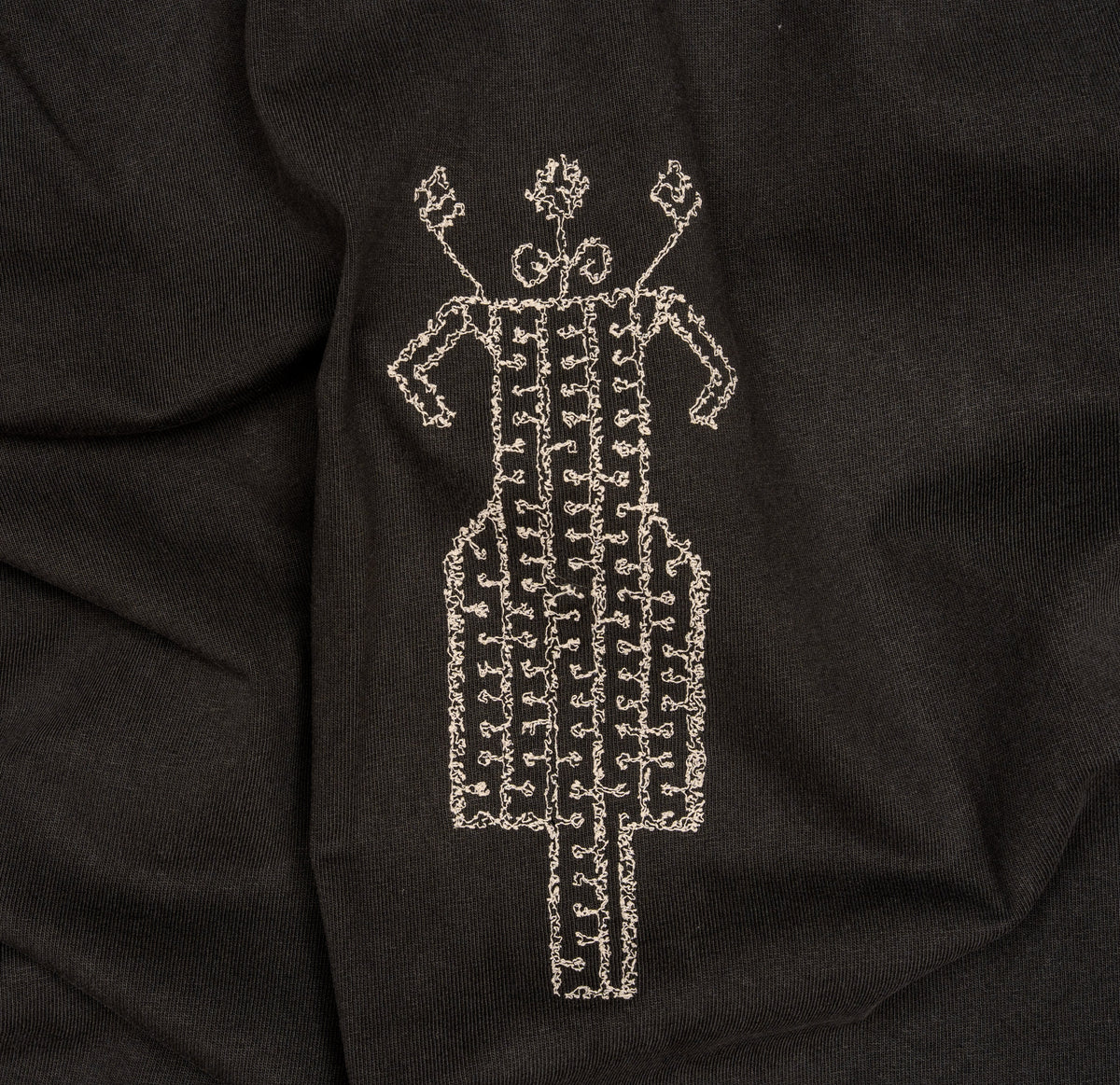
The Ward
A trace of another maker’s hand.
The Ward begins with a piece of antique folk embroidery whose exact origin remains untraced. Its small forms, repeated lines and open spaces find a new setting on cotton. In black thread, the motif carries a fragment of that textile memory into everyday wear.
Embroidered in the Gordina studio, the Netherlands.
Choose a pattern