
Gordina Journal
The Ward
A Trace of Another Maker’s Hand
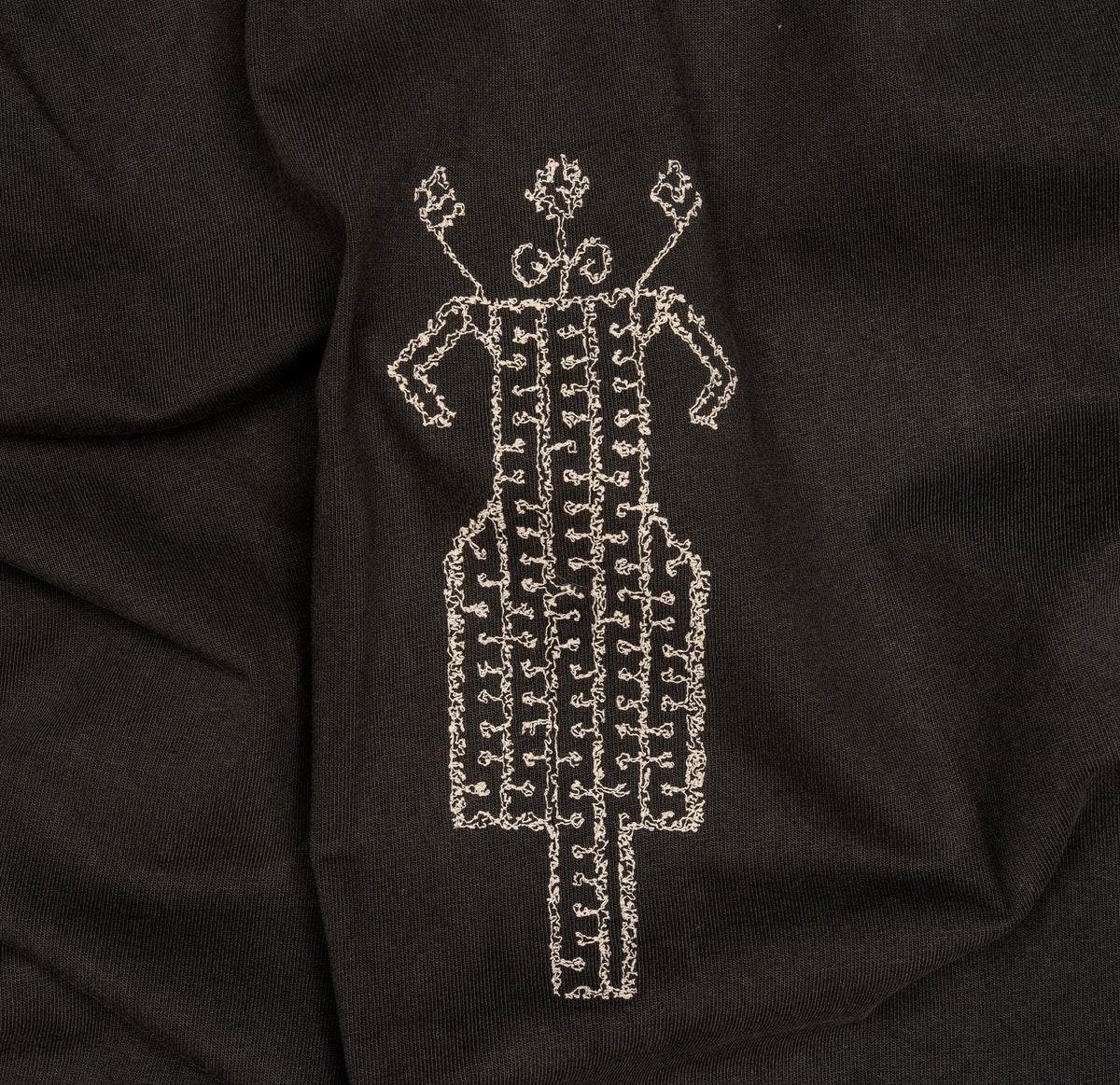
The Ward begins with an antique embroidery reference whose maker and exact origin remain unknown. Gordina follows its rhythm, spacing and repeated forms, translating a fragment of textile memory into contemporary embroidery.
Some patterns arrive with names, places and dates. Others survive differently.
The Ward begins with a piece of antique folk embroidery whose maker and exact origin remain unknown. What remains is not a full history, but a fragment: a repeated horse-and-rider composition carrying rhythm, repetition and the memory of a hand at work. Rather than treating that source as a decorative image to be copied, Gordina approaches it as a textile trace — something observed closely, then translated into a new embroidered composition.
From the source
The starting point is modest in scale, but rich in structure. Small forms repeat. Lines return with measured variation. Open spaces matter as much as stitched ones. The composition holds together not through spectacle, but through balance.
This is part of what makes antique embroidery so compelling. Even when the maker’s name is lost, the logic of the hand remains visible. Decisions about spacing, direction and repetition still speak through the textile.
In The Ward, those qualities are not reproduced literally. They are followed.

A pattern passed into thread
Gordina’s interpretation keeps close to the source’s rhythm: its contained scale, its repeating marks and its sense of order carried lightly across the surface. The design does not try to become a historical reconstruction. Instead, it asks what can be carried forward.
What remains when origin is uncertain? Often, it is the pattern itself — and the gestures that made it.
That is where The Ward begins: not with full certainty, but with attention.

Repetition, space, and memory
Many historical embroideries are built from small systems. A form appears, then returns. A line creates direction. Empty ground allows the stitched areas to breathe. The eye moves not only across thread, but across pause.
This relationship between stitch and space is central to The Ward. The motif feels held together by intervals as much as by marks. The embroidered forms do not cover the fabric completely; they leave room around themselves. The cotton becomes part of the drawing.
This is one of the quiet strengths of embroidery. It does not only add form. It also frames absence.
From archive to everyday wear
At Gordina, historical references are not treated as static images. They become starting points for garments intended to be worn. Embroidery allows a pattern to keep its intimacy while taking on a new function.
In The Ward, thread carries forward a fragment of anonymous textile memory and places it on cotton: not as a quotation, but as a continuation. The result is contemporary, but its pace remains close to the source — measured, deliberate and tactile.
Reddish, tonal and cream thread each shift the feeling of the motif slightly, while the underlying structure remains the same: a remembered form, reworked by another hand.

Why “The Ward”?
The title suggests holding, keeping or standing watch over something fragile but worth carrying forward.
That gesture feels appropriate here. The source behind The Ward is incomplete in the best sense: it leaves space for care, interpretation and continuation. Gordina does not claim to restore a lost whole. Instead, the design gives a small visual memory another life in thread.
A fragment carried forward
There is something moving about patterns that outlast attribution. Even when the maker’s name is unknown, the work itself continues to travel — across fabric, across time and across other hands.
The Ward is Gordina’s way of staying with that trace.
It begins with an old embroidered source. It continues in cotton, stitch and everyday wear.
